
More people than ever are looking for functional medicine doctors — and it makes sense. Many people are tired of care that only manages symptoms. They want care that asks, “Why is this happening?”
That root‑cause mindset is changing how we think about health. It also makes room for a whole‑person view of the body. Functional medicine doctors and muscle testing practitioners (also called applied kinesiology practitioners) often aim for the same outcome. They want to understand what the body needs to get back into balance.
How Functional Medicine Doctors and Muscle Testing Practitioners Work Toward the Same Goal
More people than ever are seeking out functional medicine doctors — for good reason. Many are tired of symptom-based care that never explains why issues keep returning. There is a growing demand for healthcare that looks deeper and asks better questions.
This shift toward root-cause healing is changing how we view the body. It also creates space for a more whole-person approach to wellness. Functional medicine and muscle testing (applied kinesiology) are two paths that often point in the same direction. When used together, they can offer a fuller picture of what the body is communicating.
What Does a Functional Medicine Doctor Actually Do?
A functional medicine doctor views the body as an interconnected system. Symptoms are not treated as isolated problems. Instead of asking, “What medication treats this?” the focus is, “Why is this happening at all?”
To answer that question, functional medicine doctors rely on comprehensive lab testing and detailed patient histories. They also examine lifestyle factors, environmental exposures, and genetic influences. For many patients, this approach feels different in the best way. People who have spent years seeing specialists without answers often feel truly heard for the first time.
Common concerns that bring people to functional medicine include chronic fatigue, autoimmune issues, gut dysfunction, hormonal imbalance, and ongoing inflammation. The work is grounded in systems biology. This means the body’s systems are deeply connected, and healing requires addressing the whole person. The Institute for Functional Medicine offers an excellent foundation for learning more about this model.
The Core Philosophy They Share: Starting With “Why”
Functional medicine and muscle testing (applied kinesiology) share a core belief. The goal is not symptom suppression. The goal is understanding why something is happening and what the body needs to restore balance.
Functional medicine looks through a biochemical lens. Blood work, stool tests, hormone panels, and inflammatory markers reveal patterns within the body’s chemistry.
Muscle testing approaches the same question through an energetic lens. It uses frequency-based assessment to identify stress patterns and disruptions in energy flow. These patterns can point to systems that are struggling on a vibrational level.
Different tools. The same north star.
Where Muscle Testing Fits Into a Functional Medicine Approach
Muscle testing can be thought of as an energetic layer that complements functional medicine testing. One looks at chemistry. The other looks at energy.
A functional medicine doctor may see elevated inflammatory markers or hormone imbalances on labs. A muscle testing session can reveal energetic stress patterns that help explain those findings. Sometimes these patterns appear before changes show up on blood work. Other times, they explain why symptoms persist even when labs look “normal.”
It is important to be clear about roles. Muscle testing does not replace medical diagnostics. It does not diagnose disease. Instead, it offers another perspective. That added layer can support the body’s response to treatment and highlight areas worth deeper exploration.
For example, someone may be on a gut-healing protocol with a functional medicine doctor. A muscle testing session may show strong energetic stress in the digestive system. Often, those findings align closely with what labs already show, reinforcing the healing path.
Why Root-Cause Healing Often Requires More Than One Modality
The human body is not chemistry alone. It is both biochemical and energetic. No single tool captures the full picture.
Functional medicine excels at identifying physical and chemical imbalances. Lab data is powerful and necessary. Yet deep healing often involves layers labs cannot fully measure. Stress patterns, nervous system dysregulation, and energetic imbalance all influence how the body functions.
This is why many integrative practitioners support multi‑modal approaches. The more perspectives you bring together, the clearer the picture becomes.
What Collaborative Healing Looks Like in Practice
There is no single “right” starting point for root‑cause healing. The journey can begin in different ways, with the same end goal.
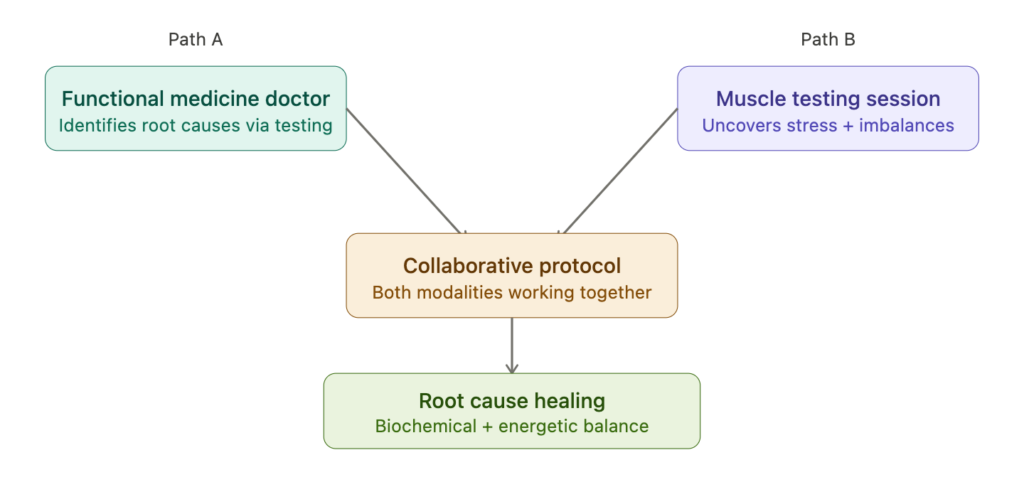
Path A: You begin with a functional medicine doctor. Testing reveals key drivers such as dysbiosis, adrenal stress, or inflammation. You follow a targeted protocol. Muscle testing is added as energetic support to help the body adapt and respond.
Path B: You begin with muscle testing. Energetic stress patterns surface around areas like the gut, thyroid, or nervous system. Those insights are shared with a functional medicine doctor. The doctor then orders more targeted labs based on those clues.
In both paths, chemistry and energy work together. Each approach informs the other. The result is care that sees the whole person.
Is Muscle Testing Right for You if You’re on a Functional Medicine Path?
If you are already working with a functional medicine doctor, muscle testing can be a natural complement. It can also be helpful if you are just beginning to explore root‑cause wellness.
This approach is best suited for people who are committed to deeper healing. Openness to addressing the body on multiple levels matters more than where you start. You do not need to choose between modalities. Many people find that using both provides greater clarity and momentum.
If you want to discuss it with your functional medicine doctor, keep it simple. Frame muscle testing as energetic support alongside your current protocol. Most practitioners appreciate informed, proactive patients.
Ready to Explore the Next Layer of Healing?
If you are curious and ready to learn about how muscle testing (applied kinesiology) could support your healing journey, I would love to connect.
You can book a full‑body muscle test scan to explore potential root causes behind your symptoms. The scan can also help determine whether additional labs might be supportive. These may include Hair Tissue Mineral Analysis, Organic Acids Testing, or a comprehensive hormone panel.
Frequently Asked Questions
What is the difference between a functional medicine doctor and a muscle testing practitioner?
A functional medicine doctor is a licensed physician who uses advanced testing and clinical history to identify biochemical root causes. A muscle testing practitioner assesses the body’s energetic state using frequency‑based muscle testing. Both share a root‑cause philosophy, but they work through different lenses.
Can muscle testing complement functional medicine treatment?
Yes. Many people use muscle testing alongside functional medicine care. The energetic insights often support and expand what lab testing reveals.
Do functional medicine doctors recommend muscle testing?
Some integrative and functional medicine physicians are open to it as a complementary tool. It’s important to have open communication with your provider.
What does root‑cause wellness mean?
Root‑cause wellness focuses on addressing the underlying drivers of symptoms. This is the core principal of both functional medicine and muscle testing .
Curious whether muscle testing (applied kinesiology) is the right fit for your healing journey? Integrative Health Austin works with clients virtually worldwide, supporting those who are already working with functional medicine doctors and those new to root‑cause care. Visit Integrative Health Austin to learn more and take the next step.
